Don't Make the Argument
The battle cry of the reactionary centrist, or how we helped usher in authoritarianism

Politics, as the saying goes, is the art of the possible. But who decides what’s possible? Including, to take one specific instance, who is deemed “electable”?
To wit, Axios reported that Democrats are “debating a fraught question.” How to force closure of the concentration camps operating across America? How to block the criminal-in-chief from prolonging and expanding the war he felt like starting? How to keep Americans from homelessness and hunger as corporations gouge prices and Republicans slash funding?
Nope. Democrats, at least the anonymous ones speaking in that Axios piece, are contemplating whether winning back the presidency in 2028 requires nominating a straight, white, Christian man. To be fair, others - notably willing to say so on the record - are pushing back at this; they also just happen to be rumored presidential aspirants at least one tick short of all those “safe for the average voter” boxes.
This article typifies the broader advice too many Democrats follow: take the pulse of “where people are” and assume that what a captive survey audience responds when paid for their attention translates to the real world and cannot be altered. To hear think tanks and consultants tell it: we must steer clear of controversial topics (read: freedom, equality, justice) and stick to the things everyone cares about. This, according to them, is how we gain power. In order to do what, it’s not exactly clear.
In other words, we can advance our cause of greater equality by refusing to advance our cause of greater equality. Unless, of course, that isn’t our cause. This specific case falls into a broader mainstream Democratic approach: don’t make the argument about “polarizing,” or “divisive” issues. The logic of Don’t Make the Argument is always the same – do not say X because it will turn off Y voters. Buried under this is the real concern: upsetting Z donors.
Former Congressmember Barney Frank used his final days to push just this approach, telling the New York Times’s Jenna Russel, “The key to liberal democracy being able to come back is to get rid of the perception, that we have allowed to grow, that the entire Democratic Party is committed to a series of very drastic social reconstructions that go beyond the politically acceptable.”(Emphasis mine.)
Beat Them by Becoming Them?
In the Bill Clinton years, Don’t Make the Argument was termed “triangulation.” With this, Clinton and his New Democrats provided a massive boost to the right-wing storyline by refusing to make the argument about the centrality of unions, the importance of welfare, the need for government, or the drivers of crime and means to prevent it. Clinton declared “the era of big government is over” while taking scissors to a threadbare social safety net and hastening the demise of family-sustaining blue-collar jobs through a massive “free trade” agreement without protections for American workers. And with this acceptance of free market framing, the New Democrats gave aid to Republicans running for office at all levels for years to come.
“Triangulation” rebranded as “centrism” absolutely eked out some immediate electoral wins, but at great long-term costs. It hollowed out the progressive base, reinforced conservative impulses among conflicted voters, and led to the politics of abandonment that would help eventually bring Trump to power two times over.
And as far as policy wins go, Clinton’s “New Democrats” call to mind Margaret Thatcher’s famous summation of her greatest achievement: “Tony Blair and New Labour. We forced our opponents to change their minds.” On both sides of the pond, respective “left” parties embraced neo-liberalism, weakened support for unions, privatized formerly public programs and diminished welfare.
Clinton’s coterie founded Don’t Make the Argument headquarters: Third Way. As Dylan Gyauch-Lewis reported in the American Prospect, “Third Way grew out of a gun safety organization…The core of [Americans for Gun Safety] AGS’s work was to be a foil to the mainline gun control movement in order to allow moderate Democrats to court gun owners. They pushed Democrats to stop arguing that the Second Amendment did not create a personal right to own firearms, which had been a mainstream legal position supported by the overwhelming majority of American history.” (Emphasis mine) Gyauch-Lewis goes on to note that Democrats’ move to the right did not get us long-term sensible gun policy. To the contrary, now we live resigned to frequent massacres and guns as the leading killer of kids.
Don’t Make the Argument has global reach. How did folks in the U.S. Midwest, Hungary, and the UK, for example, become so susceptible to the siren song of right-wing populism? Political leaders across parties allowed corporations to decimate unions and refuse to pay what they owe in wages and taxes impoverishing working people while the right offered them a rotating cast of scapegoats to blame. And instead of recognizing the true causes of the working class’s repudiation of the status quo, after each loss Democrats and other centrist parties decide their trouble is being too staunch defenders of “cultural” issues.
And each step along the way, the savvy class urged Democrats not to attempt to argue for or even speak about vital issues others might call human rights. These same thinkers kept saying Americans are moving rightward, when in reality the durable pattern cycle after cycle is rejection of whomever presently holds power.
Barack Obama ran on the politics of progressive change, both a beneficiary of anti-incumbent sentiment and a hope-fueled generator of greater support for his party. During his tenure, the right shifted to making immigrants (alongside Muslims) a favored scapegoat. No doubt attendant to these sentiments, Obama continued the immigration policies of his Republican predecessor. His two-pronged approach was, first, “prevention through deterrence” – building barriers at the border and increasing surveillance and policing; and second, “enforcement with consequences” – upping the penalties for unauthorized border crossings. And, credit where due, he got closer to passing comprehensive immigration reform than anyone had in decades, despite tough legislative odds.
Obama likely believed this would allow him to be seen as keeping to the center when he announced his Executive Order for undocumented young people to receive deferred status, or DACA, selling it as “a common-sense, middle-ground approach.”
Despite all of this, Republicans attacked Obama for purportedly being soft on the border. Obama’s successor rode down a golden escalator to announce his campaign platform of xenophobia with a side of faux populism. The centrist approach on immigration had gotten close legislatively but ultimately failed the left and fueled the right.
To be sure, the incumbent party losing seats in the midterms is the norm and Clinton presided during a massive redistricting moment that hurt Democrats. However, the scale of the losses under Clinton and Obama’s tenures, especially in their first terms, was enormous. More critically, these same consultants just kept dishing out the same advice that routinely failed at the Congressional, state and local levels.
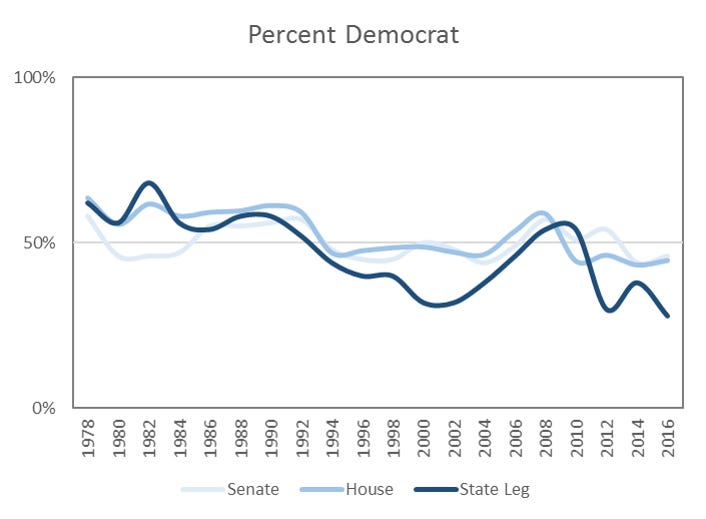
(Image from Nick Hillman, University of Wisconsin, Madison. Lines correspond to percent of seats held by Democrats in the Senate (lightest blue), House (medium blue), State legislatures (darkest blue) from 1978-2016.)
In post-2016 election analyses, long-time Democratic insiders lectured candidates and elected leaders about the need to reign in their destructive impulses to cater to the left. This time, they marked “identity politics” as the cause of Hillary Clinton’s loss. Mark Lilla penned the op-ed that gave rise to a genre: white guy finger-wagging at Democrats for daring to mention, let alone advocate for, racial or gender justice. In his book, The Once and Future Liberal, Lilla declared, “Black Lives Matter is a textbook example of how not to build solidarity.” Never mind that Black Lives Matter came into being as an outcry in reaction to the murder of Treyvon Martin as he was walking home with Skittles, not as an electoral slogan or “big tent” pitching exercise. “Don’t talk about race” isn’t a useful admonition when your issue is quite literally race.
Today’s campaign commentators and Democratic operatives often deliver pronouncements similar to Lilla’s with resignation. They wish that addressing the injustice of policing or supporting immigrant rights didn’t pave the way to Democratic demise; but we must face facts. Never noting that silence on these issues simply allows the right to keep upping the ante, which, if you care about justice, should concern you. Even if you only care about winning elections, you are making this task more difficult for yourself. Because, and here is the reality consultants pitching versions of Don’t Make the Argument can’t seem to grasp: what people believe about Democrats isn’t determined by what Democrats say but rather what others – including Republicans and voters’ trusted networks of friends and family – say about them.
Same Idea, Different Branding
Beginning in Trump’s first term till today, right-wing attacks have become even more broadly directed. What Lilla referred to as “identity politics” got rebranded as “cultural issues” and eventually “wokeness.” These designations can now encompass everything from abortion to trans rights and from teaching true history to immigration. This relaunch of hand wringing over what we ought not be mentioning and who we must not offend offered a way to repackage the directives from earlier decades, often made by exactly the same people.
Thus, it was no surprise that in the march to the 2022 midterms, it was Back to the Future as pundits and pollsters peddled Democrats the same advice they offered in the 80s: be palatable to centrists, which means not giving into leftist impulses to fight for human rights for groups for whom they’ve always been denied. Just as reliably, this idea got a new name: Popularism.
In the New York Times, Ezra Klein broke down the definition of Popularism: “Democrats should do a lot of polling to figure out which of their views are popular and which are not popular, and then they should talk about the popular stuff and shut up about the unpopular stuff.” In other words, take voters’ views as given and Don’t Make the Argument to move them.
Talking about the positions you hold that voters like is, to be sure, often a good thing to do! It’s also about as sophisticated an analysis as your financial advisor telling you to make more money and spend less. And if voters were rational actors with fixed and neatly bundled policy preferences, who made political decisions as atomized individuals, based on the utterances of Democratic politicians and their affiliated organizations, this could be effective advice. But they aren’t and they don’t. Instead, they are human beings whose political preferences and behaviors are formulated inside of social networks, based on often conflicting beliefs and what they take to be the “common sense” consensus of the people they trust. If they hear Democrats’ messages at all – a dubious claim given the cacophony of modern life – they do so filtered through all sorts of biases including which issues are worth paying attention to based not on their pre-registered preferences but rather which issues are getting all the airtime.
Reliance on what’s privately popular, as reported in surveys people take as individuals, creates a false idea of what would be publicly motivating. In other words, cause voters to take visible action thereby raising the saliency of that concern and creating a new “common sense” of what “people like me” not only believe but do in response.
Avoid the “A-Word”
This advice about what to say is also guidance on what to avoid, about which not to argue: anything deemed too divisive by the data gurus dishing out this counsel. For a long time, abortion was the textbook example. Even our most recent Democratic presidents, Obama addressing Planned Parenthood and Biden defending Roe v. Wade, stuck to what Politico called “the euphemism imperative” also known as not uttering “the a-word.”
Democratic leaders’ relative silence about and unwillingness to commit to a position on abortion – even promoting anti-choice candidates – allowed the right to fill the vacuum. States passed more restrictions and Republicans fully embraced the most destructive positions of the choir they had organized to act as unrelenting repeaters of their arguments. Yet still, most Democrats refused to make clear to voters precisely what was on the line, what they stood for and were willing to protect.
Notwithstanding the efforts of activists and with notable exceptions by individual elected leaders, Democrats largely vacated the rhetorical field. As such, they allowed the opposing team to dominate discourse about abortion and its meaning as an element of electoral politics. Republicans took full advantage and scored local, state, and national “touchdowns,” riling up their fans, many of whom became single issue voters on abortion. In case you’ve wondered how it’s possible that a right taken as a given is now banned in many states while pregnant women are facing elevated risk of death – now you know. And, in fact, the right, true to their “always make the argument” ethos, is now pushing for criminal charges for women who abort.
Even as lawmakers were snatching abortion from millions, most mainstream Democrats were unwilling to make this a talking point in the 2018 midterm election. In their comprehensive analysis of 2018 political ad spending, Erika Franklin Fowler, Michael Franz, and Travis Ridout detailed how Democrats swamped Republicans in terms of volume in television ads. More than half of ads for Democrats mentioned healthcare. Yet one “healthcare” issue that rarely got any mention? Abortion.
Despite this, the 2018 election saw record turnout, with Democratic voters fired up even beyond the out-of-power insurgency of every midterm elections. Indeed, these folks didn’t just vote – they brought a record 117 women into office: 100 Democrats and 17 Republicans.
Then in 2019, as Guttmacher Institute reported, “conservative state legislators raced to enact an unprecedented wave of bans on all, most or some abortions, and by the end of the year, 25 new abortion bans had been signed into law, primarily in the South and Midwest.”
The following year, with the 2020 presidential election fast approaching, Trump further packed the Roberts Court after Ruth Bader Ginsburg’s death. Leaders from reproductive rights organizations kept crying out to raise this issue more often, more urgently, and more unequivocally. Still, according to an internal memo by Democratic strategist Dan Ancona analyzing AdImpact reporting, of the nearly $243 million spent on television advertising by Democrats just in House races, only 1.5 percent went to ads that mentioned abortion.
Fast forward to the 2022 midterms. Even when the Alito decision on Dobbs leaked in May, giving us a glimpse that Roe was on the chopping block, only avowedly pro-choice groups like Planned Parenthood and EMILY’s List were headlining abortion in their messaging.
Then came the Roberts Court’s decision overturning Roe vs. Wade in June. The White House held its tongue for nearly a week and then contemplated what to propose for another while Democratic base voters out in the streets begged for decisive action. House Speaker Nancy Pelosi famously took to the podium to read a poem.
Instead of seizing not just the mobilizing ire of the base but the enormous opportunity to capture swing voters – White House Communications Director Kate Bedingfield said, “Joe Biden’s goal in responding to Dobbs is not to satisfy some activists who have been consistently out of step with the mainstream of the Democratic Party.”
In other words, Democratic leadership didn’t merely fail to channel the potent, electorally beneficial anger Dobbs unleashed – they contemplated how to contain it. At that point in the cycle, once again, mainstream Democrats and the advisors counseling them were on default mode: Stick to issues that aren’t polarizing and, if speaking of abortion, take a measured approach.
Then in August, voters in ruby red Kansas passed a ballot initiative to preserve abortion by a wide margin. Suddenly, Democrats’ best message – even by “popular” consensus – became putting access to abortion front and center. With clever word play to “Roe, Roe, Roe the vote,” the month of the election was renamed “Roevember.”
Did Dobbs bring concern about legal access to abortion top of mind for voters? Absolutely. But did it suddenly turn abortion opponents into supporters? Absolutely not. There was already an existing, sizable cohort of people who favored legal abortion and were willing to vote for it.
In fact, in arguably merited irony, after Democrats had danced around the “a-word” for decades, campaigners for abortion access ballot initiatives eschewed the D-word. They were loath to associate these efforts with a party less popular than their issue.
The clear and present threat that overturning Roe represented changed the calculus on what mattered to voters. But the notion that making an electoral argument about reproductive freedom is unwise was wrong all along. The refusal to talk about abortion made the threats to it less visible, and with it our political opponents seem less dangerous.
From the A-Word to the I-Word
Rinse and repeat on immigrant rights. Arguably, the last national political figure who made a consistent argument that immigration is good was Ronald Reagan. Reagan said, “Our strength comes from our own immigrant heritage and our capacity to welcome those from other lands.” Mainstream Democratic leaders since then have, to be sure, said positive things about groups of immigrants, such as DREAMers. But they have fallen short of really making the argument that we are all the better for having newcomers here – not just in objectifying economy-boosting terms, but in cultural, social and moral ones.
Then, throughout the 2024 election, pundits touted voters’ approval for “mass deportation,” failing to remark that in those same polls approval for a “pathway to citizenship” matched or eclipsed it. All the while, Democratic operatives admitted they struggled to find effective negatives against Trump, never realizing the trouble was that too few voters believed Republicans would implement the plans he ran on. Again, failure to make the argument about the depravity and criminality of MAGA’s plans made them seem less likely to come to fruition. This made voting for Trump or staying home seem less dangerous.
Then, even though they campaigned on championing Republicans’ “tough on the border” plan, Democrats bought the 2024 post mortem punditry that they hadn’t offered voters enough xenophobia. As such, many Democrats came into Trump II not merely tepid in their defense of immigrants but active partners in stripping immigrants accused of committing a crime of due process, aiding the current all out assault on anyone MAGA calls “illegal.”
In stark contrast, when Senator Van Hollen went against Democratic leadership’s dictates and flew to El Salvador, he helped not only get Kilmar Abrego Garcia released from prison there, he got more of the public to see what MAGA was doing. He made the argument and with it helped begin the shift that MAGA’s own actions and the courageous resistance of everyday people from LA to Chicago to Minneapolis hastened.
And then MAGA made the rest of the argument for us. Over the course of 9 months, disapproval of ICE has skyrocketed to put the agency underwater and now the majority of Americans support abolishing ICE, a phrase most Democrats are still unwilling to utter due to their belief that doing so will make them seem “anti-enforcement.” As if ICE actually exists to “enforce immigration policy,” when its true mission and core purpose is to terrorize and vilify anyone deemed “other.”
Take Care How You Oppose the Opposition
While “cultural issues” tend to get marquee billing in the debate about not debating, Don’t Make the Argument extends to not making the case against the party you are running against.
As Republicans keep increasing the speed, reach and rabidness of their authoritarian assaults, some consultants are worried Democrats have been too negative against Trump. The Bulwark’s Lauren Egan reported in May that Democrats were reluctant to bring up Trump’s obvious physical (not to mention cognitive) decline out of fear that it “risks sending his voters—some of whom the party needs to win over—a message that Democrats think they’re morons for having backed him.” She added that Democrats preferred the refrain that “Trump lied to you about everything, from lowering costs to ending forever wars.” Why previous Trump voters would not feel rebuked at Democrats telling them that they believed and backed a liar but would feel affronted to hear they had voted for someone who is getting older remains unclear. Regardless of the logic and whether one form of attack is better than the other, the guiding concern is fear around making every possible argument against their chief political rival.
As we’ve seen since inauguration, many Democrats have voted for Trump’s political nominees even this year, backed his original spending bill, demonstrated reluctance to repudiate MAGA or call for impeachment, and focused on social media derision over organizing voters into direct action. Previously, they have promised to undertake “bipartisan legislation,” in other words, act as governing partners with the people they’ve told voters are an existential threat to our very way of life. Or extended them credit for helping pass legislation Democrats were trying to hype, even as most Republicans tried to destroy it.
As Noah Berlatsky put it, “if you attempt to meet fascists halfway, you are pushing the country towards fascism—and betraying your allies and marginalized people in the bargain.” It is difficult for voters to credit dire warnings when the people delivering do not behave as if they were true.
Pay to Polarize: Making Climate Change Untouchable
The main thrust of Don’t Make the Argument claims revolve around a generally unspoken notion: the purpose of politics is to win campaigns for the sake of doing so. Eeking out fifty percent plus one requires sticking to poll-tested issues and espousing widely agreed upon stances. The business of governance, in other words, enacting an agenda, is an after thought. Anything too “polarizing” is best left unsaid.
Polarizing is pundit-speak for “both sides.” It is a way of misdiagnosing our political problem as everyone displaying increasing “extremism,” equating the effort to install authoritarianism with the outcry for equality and justice for all.
What parties and voters deem “polarizing” changes over time. Before the 1973 Roe decision that legalized abortion, Republican leaders supported the procedure as did the majority of their voters; Reagan championed amnesty for immigrants as governor and president and most Republican voters at the time endorsed those views. Polarization is propelled by the asymmetry between the right promoting their arguments regardless of how unpopular and unhinged while mainstream Democrats avoid voicing views and admonish their left wing colleagues and activist groups for daring to do so.
Now, “polarizing” topics include our very ability to survive on the planet, also known as climate change. This did not used to be so. In the late 1980s, President George H.W. Bush campaigned on conservation and addressing greenhouse gases, stating “These issues know no ideology, no political boundaries. It’s not a liberal or conservative thing we’re talking about.” Back then, addressing climate change was everyone’s cause – until the Kyoto Protocol made it clear that doing so required actually confronting the corporations minting their fortunes off polluting our air and endangering our future. This led those corporations to spend fortunes pushing the message that climate change was part of a “liberal agenda” and thus Republicans backed away from the issue.
This left Democrats as the tellers of the “inconvenient truth” of this cause to varying degrees of frequency, focus and fervor. By 2018, demanding solutions to the problem of having a habitable earth spliced apart mainstream Dems from progressive challengers. Perhaps most famously embodied in Representative Alexandria Ocasio Cortez’s protest at House Minority Leader Nancy Pelosi’s office in solidarity with the Sunrise Movement.
But now, climate change has joined the category of topic which shall not be named. Analysis of recent congressional Democrats’ press releases finds these failing to mention the climate, a practice now widespread enough it has been given a name: “climate hushing.” It has also gotten the requisite New York Times op-ed declaring “Democrats Don’t Have to Campaign on Climate Change Anymore.” The all-too-familiar advice is “the candidates’ first task must be to regain credibility with working people by tackling their more immediate, material concerns.” This sentence could be and indeed has been previously written about everything from abortion to immigrant rights to police violence. And it stems from the very same source: polls where voters register their issue concerns and what tops them.
Speaking of polling, Gallup asked a critical set of questions that shows the destructive impact of Don’t Make the Argument – turning what people perceive as social consensus against your cause and thus hindering your ability to win it. Where 50 percent of Americans, an admittedly low number given our reality, believe climate change is a “serious threat,” they guess that only 10 percent of their fellow Americans believe this too. This chasm between what people think and believe others think directly impacts what is deemed “politically possible” in a way that is purely a product of political cowardice not actual strongly-held, unchangeable views.
With issues like abortion or LGBTQ equality, religious convictions and cultural traditions come into play. Issues like immigrant rights, police violence and DEI, have deep-seated identity and social cohesion dimensions to them. Climate change, in contrast, does not fall naturally into these “charged” categories. This is why climate change is the issue that reveals the truth hiding in plain sight: Don’t Make the Argument has never been about the preferences of the people but rather about the wishes of the wealthy. Corporate and billionaire cash determines which arguments have a purported electoral cost to them. And hire data dudes to ask the right questions to “prove” this is so.
The Only Way to Win Is to Make the Argument
You cannot achieve greater equality, justice and shared prosperity, not to mention sustain a habitable space for living, by refusing to ever discuss these issues. Safe to say, we would not have women’s suffrage had leaders never spoken about it. Ditto for Civil Rights, labor laws, the Americans with Disabilities Act, Marriage Equality, environmental protections, public schools, and the list goes on. And not merely made the argument, but rather sustained it through very rough times and very unfavorable polling (if it existed at the time.)
To be sure, the above are longer term issue propositions and a big part of enacting an agenda requires winning short-term fights called elections. But it turns out, not only making the argument but actually selecting which argument will rise to and remain at the fore is a winning electoral approach as well.
The marquee example of this is, of course, Zohran Mamdani. His come from obscurity rise to victory was punctuated by forcing his favored issues into public view: freezing rent, free childcare and free buses. At every point, he made the argument. When folks clapped back about impracticality, he reminded them of long standing free public transit in the form of the Staten Island Ferry. When they cried out about blowing the budget or accused him of being anti-rich, he doubled down and declared that billionaires should not exist and insisted on taxing them. Then he upped the ante some more and took the piss out of the Hamptons set with a satirical reading of their freak out.
And sure, the Don’t Make the Argument choir sings, this is the People’s Republic of New York, if you can make it there, you can’t make it anywhere else. But this is also the place that elected Eric Adams and Michael Bloomberg, where people truly believed Mamdani had no chance until they came around to dismissing his win as an inevitable and place-specific fluke. Mamdani actually did need to make the argument and won not despite but because of it.
Further, when you win by making the argument, instead of running from it, it helps set others up to win as well because people are attracted by your affirmative agenda not merely your critique of the other side. And, most importantly, it sets you up to actually govern – to enact the agenda you described and used to attract supporters to not merely vote for you but tell others to do the same.
“… we can advance our cause of greater equality by refusing to advance our cause of greater equality.” This was such an informative read.
Thank you!
What an amazing article!! THANK YOU. The history of how we got here based upon apathy of the Democratic Party.